
Because your customers deserve solutions, not scripts.
Customer Support Where Every Agent Performs Like Your Best
While others replace humans with AI, we orchestrate AI with human intelligence. The result is customer support that combines machine efficiency with the empathy, intuition, and problem-solving that only humans possess.
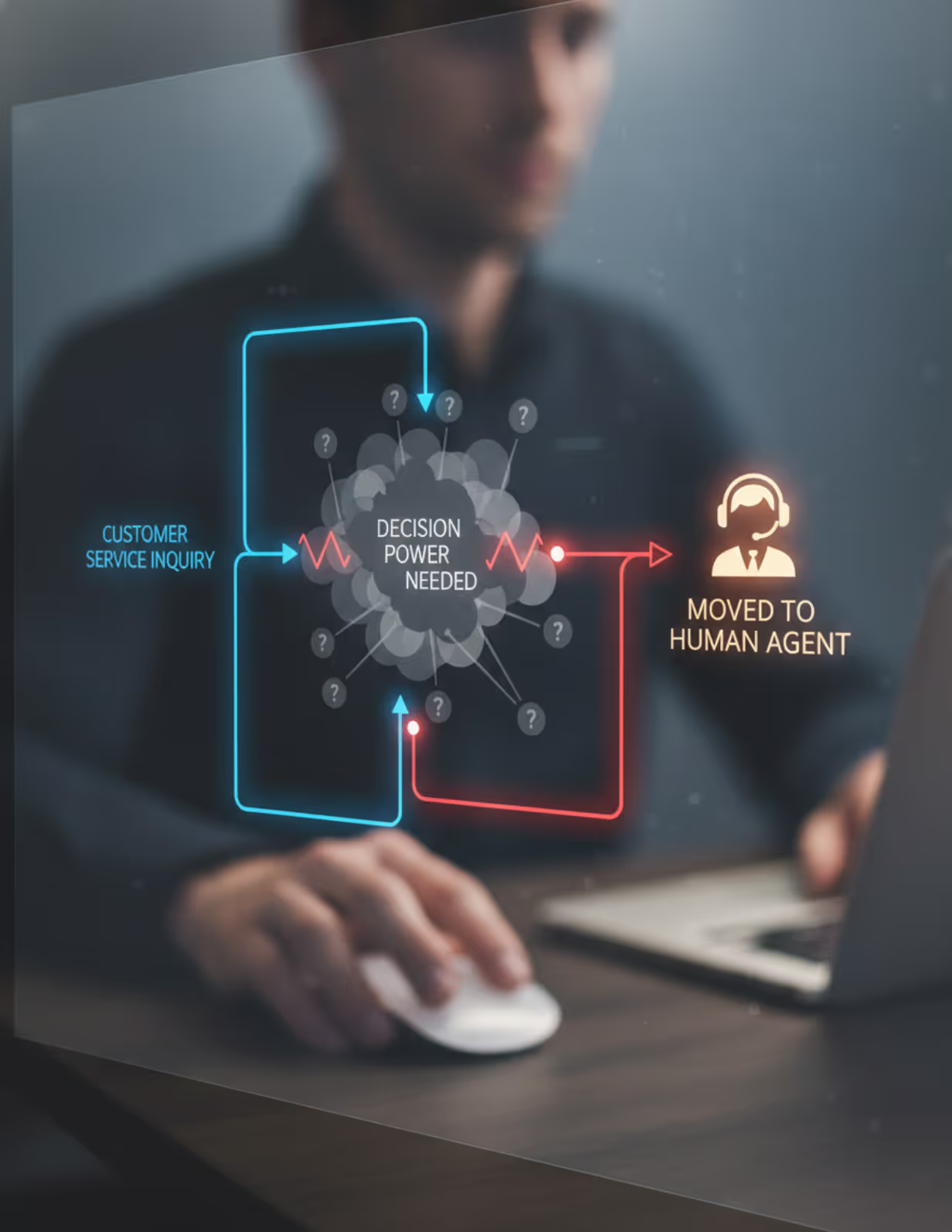
The Problem With AI-Only Support
AI excels at logic. Give it data and patterns and it handles repetitive tasks brilliantly.
But customer support is not just about data. It's about new situations where there is no precedent. Emotional intelligence when customers are frustrated. Creative problem-solving when the script does not fit. Intuition to sense what a customer really needs. The judgment to know when to break the rules.
As long as interactions stay routine, AI performs well. The moment a customer needs imagination, empathy, or novel thinking, AI-only solutions fail.
That is why AI will never run customer support alone, and why human orchestration changes everything.
The Four Primal Powers
CertainlyCx is built on a truth backed by neuroscience: humans possess primal intelligence that AI cannot replicate. Your brain has evolved over 500 million years to handle exactly what AI cannot: volatility, uncertainty, and situations that demand novel solutions. Your team has four powers that no algorithm can match.

Intuition
Your agents don't just match patterns. They spot exceptions. The "off" detail in a customer's voice. The unusual request that signals a bigger issue. This is what separates great support from scripted responses.

Imagination
When customers present problems nobody has seen before, your team doesn't freeze. They create new solutions. This is story thinking in action: the ability to plot a path forward without precedent.

Emotion
Your customers aren't data points. They're frustrated, confused, or anxious. Human agents read emotional cues and respond with empathy that builds loyalty, not just resolves tickets.

Common Sense
Your best agents know when to follow policy and when to bend it. They balance efficiency with humanity. That wisdom comes from understanding the full story of a customer's journey, not just isolated transactions.
How Human-Led AI Actually Works
We don't replace your support team with chatbots. We orchestrate AI to amplify what humans do best.

What AI Does
AI takes on the structured work. It routes inquiries based on complexity and context. It provides agents with instant access to customer history and patterns. It automates repetitive tasks and data entry. It surfaces relevant knowledge base articles. And it handles high-volume, routine requests at speed.

The Result
The result is support that resolves routine issues dramatically faster and handles complex ones with the intelligence and care they require.
What Humans Do
Humans take on the work that builds loyalty. They read between the lines to understand what customers really need. They create solutions for unprecedented problems. They build emotional connections. They exercise judgment on when to break rules. And they turn frustrated customers into advocates.
The Science Behind It
Our philosophy is grounded in research from Ohio State University's Project Narrative on how human brains outperform AI in conditions of uncertainty. Your best support agents don't think in scripts. They think in stories. They understand the customer's journey, anticipate their needs, and imagine solutions that don't yet exist in any knowledge base. That's not a weakness in your support system. That's primal intelligence at work.
Probability Thinking
Definition
Computers process data through probability, analyzing what has happened before.
Sounds Like
"This customer's issue matches pattern #437, deploy script B."
Possibility Thinking
Definition
Humans process possibility, imagining what could happen even if it never has.
Sounds Like
"This customer is frustrated about X, but they really need help with Y. Let me create a solution."
Real-World Results
Tech Company Reduces Escalations by 67%
An AI chatbot was routing 40% of inquiries to human agents, flagging them as "too complex to resolve."
Human-orchestrated AI that recognizes when issues need empathy, creativity, or exception-handling, and immediately connects customers with agents equipped with full context.
AI stopped pretending to be human. Humans stopped doing AI's work. Each focused on what they do best.
reduction in escalations
improvement in CSAT scores
reduced average handle time
improvement in first-contact resolution
E-Commerce Brand Turns Complaints Into Loyalty
Customers were frustrated by chatbots that couldn't understand context or exercise judgment.
AI handles order status and returns. Humans handle anything involving emotion, exceptions, or creative problem-solving.
Customers felt heard, not processed. Agents felt empowered, not replaced.
NPS point increase in 6 months
increase in repeat buyers
decrease in cost per ticket
Why This Beats AI-Only Solutions
The challenge of the future is not optimizing what already works. It's figuring out what works when you don't know yet. Management optimizes existing support scripts. Leadership creates solutions for problems you've never seen. CertainlyCx gives you both.
AI-Only Support
CertainlyCx Human-Led AI
Our Three Principles

AI Should Amplify, Not Replace
Your support team has intuition, empathy, and creativity that took 500 million years to evolve. We won't throw that away to save a few dollars per ticket.

Humans Should Lead, Not Follow
When AI orchestrates humans, you get rigid scripts and frustrated customers. When humans orchestrate AI, you get adaptive solutions and brand loyalty.

Story Thinking Wins
The best support interactions aren't transactions, they're stories. A frustrated customer becomes a satisfied one or a confused user becomes an advocate. Humans create narratives.
For Every Stakeholder

For CX Leaders
Stop choosing between cost efficiency and customer satisfaction. Human-led AI delivers both by putting each technology where it performs best.

For Support Agents
Finally, technology that makes your job better instead of obsolete. Focus on what you love (solving problems and helping people) while AI handles the tedious parts.

For Customers
Get the speed of automation with the empathy of human connection. Routine issues resolve instantly. Complex problems get the attention they deserve.
Frequently Asked Questions

No. AI can only handle situations with reliable patterns and data. But the most valuable support interactions involve new problems, emotional complexity, and judgment calls. As long as your customers are human, they will need human intelligence.
Traditional approaches use AI as the default and treat humans as a backup when AI fails. We flip that. Humans orchestrate the entire experience, using AI as a tool to amplify their effectiveness. The human is always in charge.
In the short term, possibly. Long-term, no. AI-only solutions carry hidden costs: customer churn from poor experiences, brand damage from tone-deaf interactions, and missed opportunities from lack of innovation. Human-led AI optimizes for customer lifetime value, not cost per ticket.
Through narrative cognition principles. We train AI to recognize exceptions, emotional signals, and novel situations. Think of it as teaching AI to know what it doesn't know.
